
Five for Friday: Issue #5
On AI's sweep of Nobel Prizes, the State of AI Report, Google's incorporation of ads to AI Overviews, Microsoft's new AI healthcare suite, and Adobe's anti-fakery project


So this week in AI land was … unusually quiet.
No blockbuster product launches, no high-profile exits from OpenAI (as of the time of writing), and no shiny cutting-edge models that claim to do everything short of your laundry. Even the big AI players took a breather from their “pseudo-acquisition” spree (see below for more on this).
But don’t tune out just yet — there were still some juicy developments worth catching up on, and I’ve got the scoop for you!
#1 Nobel Prize Committee Flexes for AI Pioneers
AI breakthroughs recognised in Nobel Prizes for Physics and Chemistry

The 2024 Nobel Prizes in Physics and Chemistry have made history by recognising pioneers in AI, signaling a significant shift in how the scientific community views AI's contributions to fundamental research.
In Physics, Geoffrey Hinton and John Hopfield were awarded for their groundbreaking work in machine learning. Hinton, known for developing the Boltzmann machine, and Hopfield, creator of the Hopfield network, laid the foundation for neural networks that mimic brain function.
The Chemistry prize went to Demis Hassabis and John Jumper of Google's DeepMind, along with biochemist David Baker, for their pioneering work with Alphafold, an AI model for decoding protein structures.
However, these awards have sparked debate within the scientific community. The lack of a dedicated Nobel Prize category for Computer Science or Mathematics has led to what some see as a forced categorisation of AI breakthroughs under Physics and Chemistry.
Perspectives:
These events highlight the lack of a dedicated Nobel Prize for computer science, and could potentially accelerate discussions about creating a dedicated category for the field. While Turing Award is a highly coveted prize among computer scientists, it does not carry the same global prestige as a Nobel Prize.
These awards also highlight the growing interdisciplinary nature of scientific research, with AI no longer just a tool but a fundamental approach to solving complex problems across various domains. This trend may lead to a reimagining of traditional scientific categories and how we classify and reward groundbreaking research.
#2 Annual "State of AI Report" Lands
Nathan Benaich release his annual deep dive into all things AI
The State of AI Report 2024, published by AI investor Nathan Benaich, offers a comprehensive view of the AI landscape over the past year, highlighting a shift from the breakout moments of foundation models to a phase of consolidation and practical application. Among the key takeaways:
The performance gap between leading AI labs is narrowing, with proprietary models losing their competitive advantage. OpenAI's new o1 model is now back on top but the question remains how long this lead will last.
AI models are expanding beyond language processing, showcasing their versatility in multimodal applications and with supporting research across diverse fields, such as mathematics, biology, genomics, physical sciences etc.
The combined worth of AI companies surged to $9 trillion! Public AI firms are experiencing a bull market, while private AI companies, despite some large funding rounds, have seen comparatively smaller increases in investment.
Despite U.S. sanctions, Chinese AI labs continue to produce advanced models. They've managed this through a combination of hardware stockpiles, approved components, alternative sourcing methods, and cloud services access.
"Pseudo-acquisitions" have emerged as a potential exit strategy for AI companies struggling to build sustainable business models and for Big Tech to acquire their teams and resources while circumventing formal M&A processes.
Perspectives:
In my view, this "consolidation" phase in AI is not a fleeting moment but the start of a multi-year journey. While AI capabilities advance, most organisations are still in the early stages of adoption. The coming years will see companies wrestling with effective AI implementation, balancing innovation and practicality, and integrating AI into existing processes. This extended period of adjustment and learning will likely define the industry's trajectory for at least the next 3-5 years.
The emergence of "pseudo-acquisitions" as a trend reveals much about the current state of AI development and commercialisation. These arrangements, where tech giants essentially absorb talent and license technology from startups without full acquisitions, highlight the immense resources required to stay at the forefront of AI innovation. While providing a lifeline for struggling startups, this trend also highlights the worrying consolidation of AI capabilities within the already powerful Big Tech companies, potentially stifling diversity in the AI ecosystem.
#3 Google's Golden Goose?
Google begins monetising AI summaries with new ad feature

For those unfamiliar, AI Overviews is a feature within Google Search that provides AI-generated summaries at the top of search results. Powered by Google's Gemini model, it aims to offer quick, detailed answers from various online sources.
The product experienced controversy in May when it recommended people to consume rocks and use non-toxic glue to keep cheese on pizza, among other errors.
Google have now introduced ads alongside these AI-generated response. So when you ask Google how to remove a grass stain, alongside AI-generated advice about vinegar and scrubbing, you might now see an ad for a stain-removing product.
Why is Google keen on this ad integration? Its clear that our favourite search giant is feeling the pressure. With Amazon and TikTok expanding their share of the search market, Perplexity announcing the introduction of ads in Q4 of this year, and the spectre of OpenAI’s SearchGPT looming, Google is definitely starting to feel the heat.
It's worth noting that AI Overviews, and by extension this new ad feature, isn't available worldwide. It's currently absent in the EU and the UK, among other regions, and the EU’s AI Act is clearly a determinant in Google’s decision.
Perspectives:
As AI becomes more prevalent in our daily digital interactions and as AI providers start to see their cash burn accelerate due to the rising cost of model development, we're likely to see more companies attempting to monetise these touchpoints.
With AI business models still up in the air and how ads can sit alongside AI responses without eroding their “neutrality”, we should all expect to see many more experiments on this front in the coming months.
#4 Dr. Windows Will See You Now
Microsoft reveals a new suite of AI for healthcare tools
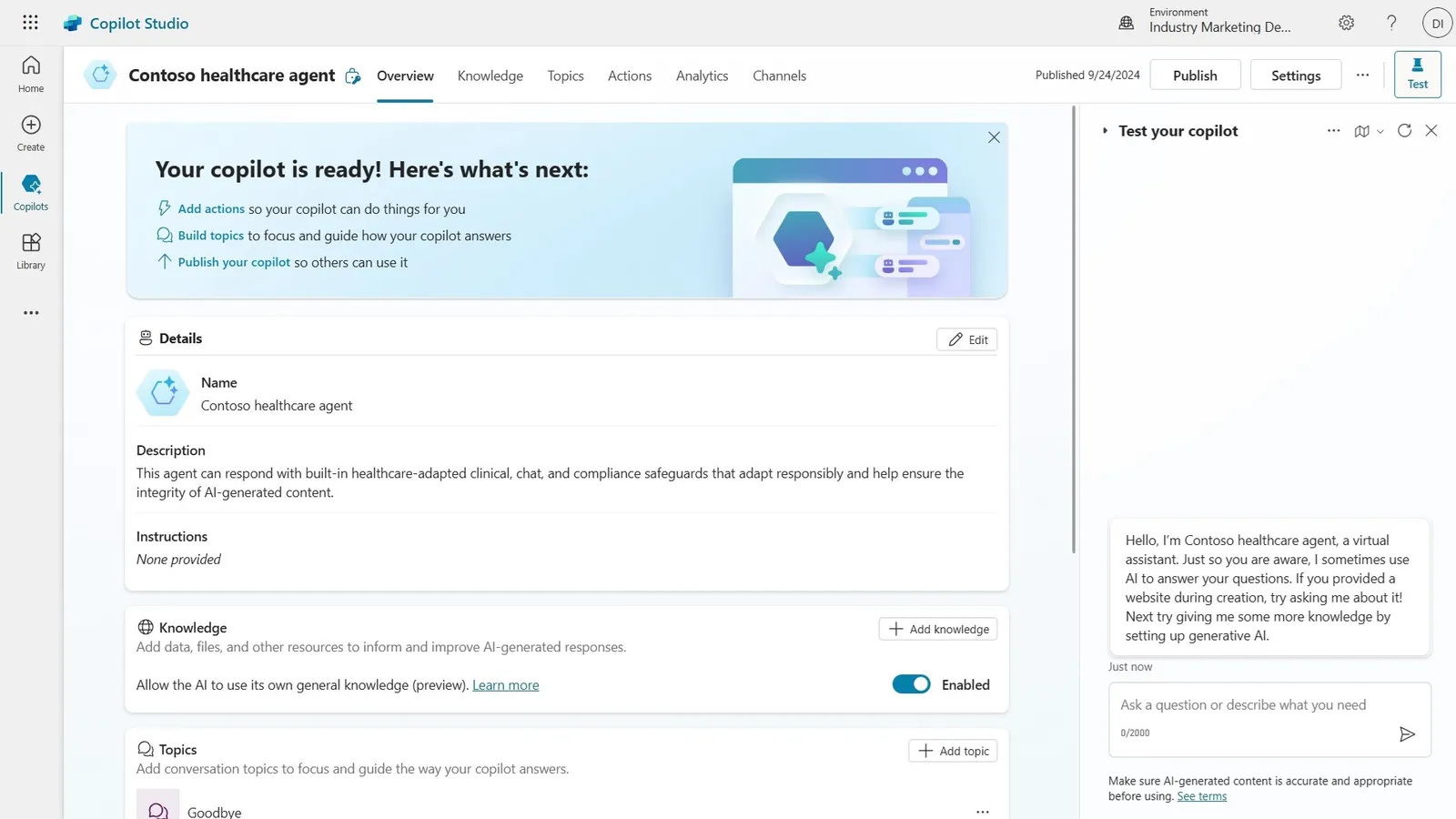
Microsoft has unveiled a suite of new tools that it hopes might just give Dr. House a run for his money (minus the attitude, we hope).
The Tech Giant's latest offering includes a collection of multi-modal medical imaging models. One example is CXRReportGen (clearly, the naming department was working overtime on this one), a model capable of generating initial reports from chest x-rays.
Interoperability (or lack thereof), healthcare's persistent headache, is getting some attention too. Microsoft is making healthcare data solutions available on its Fabric platform, providing users with the ability to “ingest data across a variety of platforms and glean insights from this data in a cohesive manner”.
Rounding out the trifecta is the preview launch of a healthcare service agent built on Microsoft’s Copilot platform. This customisable AI toolkit allows organisations to create their own virtual health assistants for everything from customer service to data parsing. US-based Cleveland Clinic has already used the platform to develop “tools that allow patients to ask health questions and navigate the health system’s services”.
Perspectives:
Microsoft's AI offerings are not new to this space. When it comes to healthcare, the real challenge lies in integration and adoption. Success hinges not just on technical capabilities, but on navigating complex healthcare ecosystems, aligning clinical, administrative and regulatory stakeholders, and overcoming resistance to change.
Furthermore, interoperability, a long-standing issue, requires more than just technological solutions — it demands collaborative efforts across the entire healthcare landscape.
And of course, Microsoft isn't the only tech behemoth playing in the healthcare sandbox. Google's Med-PaLM and Amazon's AWS are also vying for a slice of the healthcare AI pie.
#5 Adobe's Anti-Fakery Toolkit
Adobe launches initiative to combat deepfakes and content theft
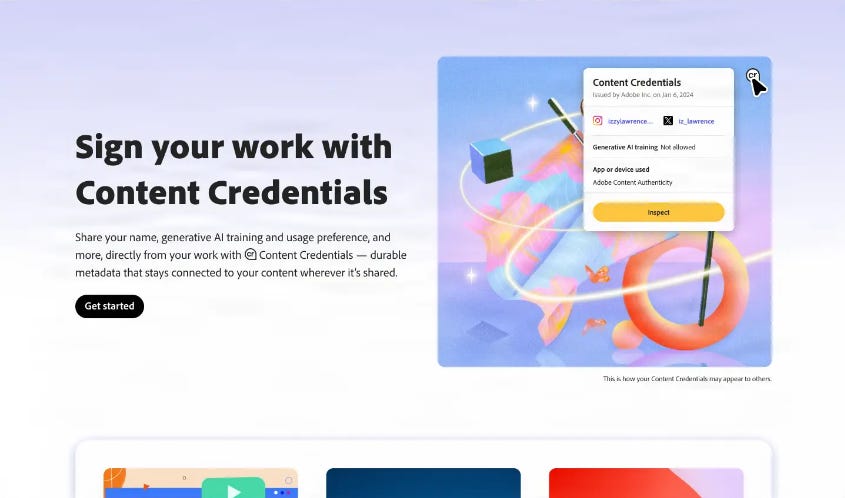
Adobe has announced the Q1 2025 launch of Adobe Content Authenticity, a free web app to help creators protect and authenticate their work, by allowing digital artists to attach "Content Credentials" to their creations to verify ownership and origin.
Content Credentials offer information about the creator and the work's provenance, and adopts a sophisticated approach to digital signatures which combine secure metadata, invisible watermarks, and digital fingerprinting to ensure the credentials remain intact even if the file is modified or shared across platforms.
There will also be a feature that allows creators to set preferences for how their work can be used in AI training.
This project is part of Adobe's broader Content Authenticity Initiative, founded in 2019, which now includes 3,700 members from across tech and creative industries and which aims to establish a standard for digital content attribution and authenticity.
Perspectives:
This initiative is a promising step, but its success hinges on widespread adoption and integration. A key near-term test will be whether Adobe and its allies can leverage its influence to make Content Credentials an industry standard and whether AI companies and other players will voluntarily honor these preferences or if regulatory measures will become necessary.
In all likelihood, any long-term solution to the problem of IP theft (and related ills) will require coalitions across diverse stakeholders, including creators, consumers, technology companies, scientists, government bodies, and regulators.
Justin Tan is passionate about supporting organisations and teams to navigate disruptive change and towards sustainable and robust growth. He founded Evolutio Consulting in 2021 to help senior leaders to upskill and accelerate adoption of AI within their organisation through AI literacy and proficiency training, and also works with his clients to design and build bespoke AI solutions that drive growth and productivity for their businesses. If you're pondering how to harness these technologies in your business, or simply fancy a chat about the latest developments in AI, why not reach out?